
By Simon Arndt · 7 min. read · Last updated: 7/20/2026
OKRs are not a new idea. Andy Grove developed them at Intel in the 1970s, and Google made them famous from 1999 onward. Yet their importance is growing noticeably right now. The reason is simple: the problem OKRs solve, aligning teams around a shared outcome, has grown in recent years, not shrunk. Distributed teams, faster market cycles and AI sharpen exactly the question OKRs answer. If you need the basics first, read our article on what OKRs are.
Remote and hybrid: alignment becomes the bottleneck
Where teams share an office, alignment often happens on the side: at the coffee machine, in a quick chat, by glancing over a shoulder. Those informal channels have broken away. Today 52 percent of remote-capable employees work hybrid and 27 percent fully remote. For distributed teams, a clear goal system is therefore not a nice-to-have but the lifeline of collaboration.
The scale of the problem shows in an Asana study: only 26 percent of employees clearly understand how their work contributes to company goals. OKRs close exactly this gap, because they make visible what a team is working toward and why. In a remote setup, that is often the only place where everyone agrees on the same direction.
Here is what a goal that holds a distributed team together can look like:
Our distributed team visibly works toward the same goals
- 01Raise the share of employees who know their contribution to company goals from 40% to 90%
- 02Link every team OKR to an overarching company goal
- 03Increase the weekly check-in rate from 60% to 95%
Faster market cycles need shorter goal cycles
Annual goals suit a world that changes once a year. That world no longer exists. Markets, priorities and technologies shift within months. A goal set in January and reviewed in December is often outdated by spring.
This is where one of the biggest strengths of OKRs lies: they shorten the feedback cycle from a year to a quarter. A team can course-correct four times a year instead of once. This cadence is not a detail but the core of what makes OKRs adaptable.
OKRs and Agile: the strategic compass
Many teams already work in an agile way, in sprints and short iterations. But Agile mainly answers the how, not the why. A team can deliver cleanly sprint after sprint and still run in the wrong direction.
OKRs provide the strategic compass that agile tactics lack. They say which outcome matters at the end of the quarter, while the sprints carry the execution. That is why the two complement each other so well: Agile provides speed, OKRs provide direction. Combine both and you get velocity with a target instead of busywork. It is no coincidence that in 2026 more and more organizations deliberately connect their OKRs with scaled agile frameworks to link the strategy and sprint levels cleanly.
Transparency beats control
When you ask companies why they adopt OKRs, they almost always name the same three reasons: more transparency, better prioritization and more effective strategy execution. The numbers back this up. Companies that work with OKRs are seen as noticeably more agile (78 versus 58 percent) and better at strategy execution (58 versus 39 percent).
The lever is visibility. Once goals are out in the open, no one has to guess what others are working on. That replaces control with orientation. It also reveals where things still break down: around 65 percent of team OKRs are still not directly linked to company goals. Making that link visible is the real work, and the point where good tools make the difference.
We become the first choice for new customers in our region
Double qualified leads per month
Raise the win rate to 25%
Halve the onboarding time
Every team OKR visibly feeds the overarching company goal.
We become the first choice for new customers in our region
Double qualified leads per month
Raise the win rate to 25%
Halve the onboarding time
Every team OKR visibly feeds the overarching company goal.
AI-driven work needs clear focus
In 2026 another driver joins in. Companies no longer scale AI as isolated projects but across the whole organization. That raises the pace and the number of parallel initiatives. Without a clear goal system, this risks turning into activity for its own sake: many experiments, little measurable impact.
OKRs give AI efforts a frame. They force the question of which measurable outcome an initiative should deliver, instead of adopting technology for its own sake. For leaders, connecting AI strategy with OKRs has become one of the central tasks of the year.
Engagement: goals people actually own
OKRs work not only top-down but the other way around too. When teams help shape their own Objectives instead of just being handed them, commitment rises. People buy into goals they understand and helped formulate. Pure top-down targets rarely create genuine ownership.
That is why many teams set their OKRs deliberately ambitious. A goal that is safely 100 percent reachable motivates no one. A goal that stretches and is still visible to everyone creates pull. This mix of ownership and transparency is why OKRs raise engagement instead of dampening it the way classic targets do. In distributed teams especially, where motivation is harder to steer from the outside, that effect becomes the decisive advantage.
What this means for teams in 2026
The direction is clear: around half of Fortune 500 companies now use OKRs as their primary goal system, and the market for OKR software is growing at double digits. But this is not a question of company size. Small teams benefit most, because distributed work and fast cycles hit them just as hard, only with less buffer. A five-person team that prioritizes wrong loses relatively more than a corporation running a hundred parallel projects.
Getting started is easier today than ever. Instead of heavy enterprise systems, a lightweight tool that makes Objectives and Key Results visible and calculates progress automatically is enough. That is exactly the kind of tool we built: the OKR App, lightweight and ideal for small teams that want to start with OKRs now.
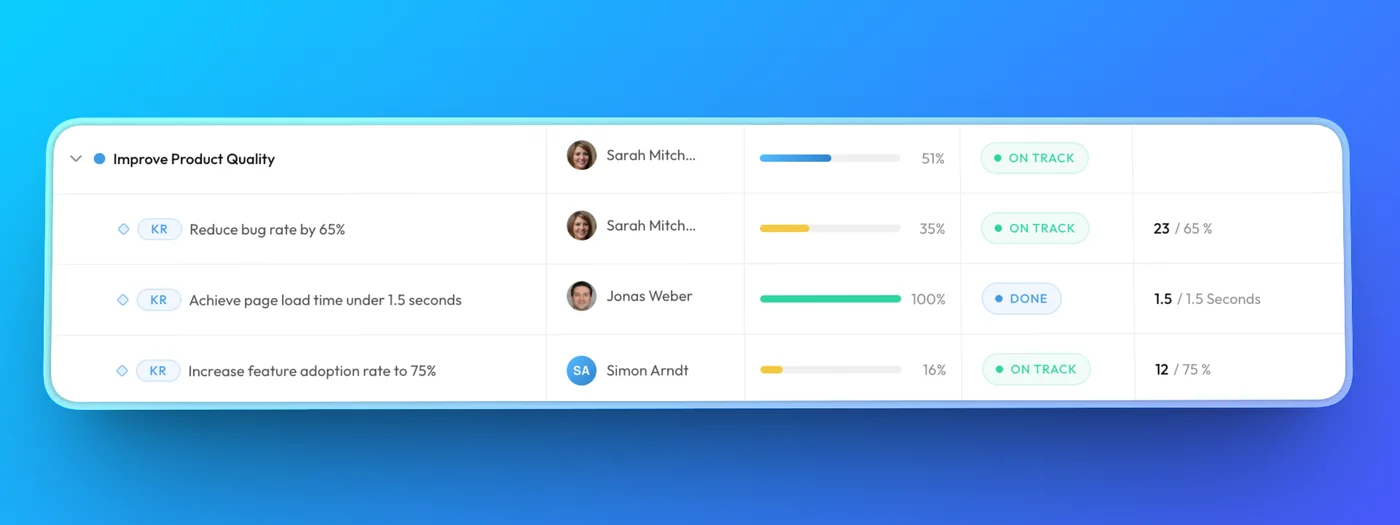
Visible goals and automatically calculated progress – exactly what distributed teams need.
If you want to take the next step, our guide on how to implement OKRs step by step gives you the concrete roadmap. And if you want to dive in right away, set up your first OKRs in it and start for free in the beta.
Frequently Asked Questions
More articles

Gamification
What Is Gamification? Definition, Elements, and Application
Gamification brings game mechanics into non-game contexts. We explain the definition, the key elements, and where companies use gamification successfully.

Streaming
What Is VTubing? Meaning, Technology, and Getting Started
VTubing explained: what a VTuber is, how the technology behind the virtual avatars works, and what hardware and software you need to get started yourself.
Ready to get started?
Let’s start your project.
We appreciate your interest in working with us. Whether you have an idea, a proposal, a question, or need assistance in another area, we’ll get back to you quickly—within 24 hours.
Free initial consultation
Response within 24h
No commitment
Contact
Get in touch
Opening Hours
Mon – Fri, 9:00 – 17:00Response Time
Within 24 hours