
By Simon Arndt · 8 min. read · Last updated: 7/20/2026
Most OKR rollouts fail not on the method but on the start. Goals get set before the cadence is in place. A tool gets picked before the process is clear. After three weeks of planning, the first quarter begins and the team is already behind. This guide shows how to implement OKRs so they actually get used day to day. If you need the basics first, read our article on what OKRs are.
Before you start: the prerequisites
Two things need to be in place before the first Objective. First, a clear why: the team has to understand which problem OKRs are meant to solve, otherwise they feel like extra bureaucracy. Second, backing from the top. Without a leader who visibly supports the process, the rollout usually fizzles out by the second quarter.
Also lock in the cadence before anyone writes a goal. The standard is a quarter. For a team working with OKRs for the first time, a shortened first cycle of six to eight weeks works well. Short enough to stay focused, long enough to see real progress.
Step 1: Start with a pilot team
The most common mistake is going big: OKRs for the whole company on Monday. It is better to start small. With up to 30 people you can begin company-wide. In larger organizations, pick one to three teams as a pilot, led by people who welcome change and carry the process.
A pilot reduces coordination overhead and delivers something more valuable: internal examples. When the rest of the company joins later, there is already a team that can show what good Objectives and Key Results look like in your context.
Step 2: Define your Objectives
Now for the goals themselves. An Objective describes what you want to achieve in the cycle, qualitative and motivating. Three to five per team are enough. More means no real priority.
Our sales team wins new leads in a predictable, repeatable way
- 01Raise qualified leads per month from 40 to 100
- 02Cut response time to inquiries from 24 hours to 4
- 03Lift the win rate from 18% to 25%
Write Objectives so that everyone on the team can repeat them in one sentence. A good Objective inspires, a weak one reads like a line from the annual report.
Step 3: Make Key Results measurable
Key Results are the part where success can be read off objectively. Each one gets a starting value, a target value and a current value. The most important rule: results, not activities. "Roll out a new CRM" is a task. "Cut response time to inquiries from 24 hours to 4" is a Key Result, because it describes a measurable change.
Two to five Key Results per Objective is ideal. If you cannot find a number to measure the outcome, it is probably not yet a Key Result but a task. Our basics article on Objectives and Key Results goes deeper on telling good ones from bad.
Step 4: Make OKRs visible
OKRs only take effect when everyone can see them. That was exactly the addition that made the method famous at Google: don't hide goals in team silos, make them visible to all. Every team member can then see how their own contribution feeds the bigger picture, and duplicated work surfaces earlier.
Connect the Objectives of different teams where they relate. A sales goal that feeds an overarching growth goal should visibly hang off it. This alignment is the difference between a collection of isolated goals and a genuine shared direction.
Step 5: Weekly check-ins
This is where it is decided whether OKRs live or die in a drawer. The most important calendar entry of the whole rollout is the weekly check-in, and you block it before the cycle starts. Same time, every week, 15 to 20 minutes. Teams that establish this rhythm in week one keep it far more reliably than those who try to add it later.
The effect is measurable: teams with weekly check-ins complete around 43 percent more Key Results than teams that only look monthly or ad hoc. In the check-in, everyone updates their values, names blockers and says what they will focus on this week.
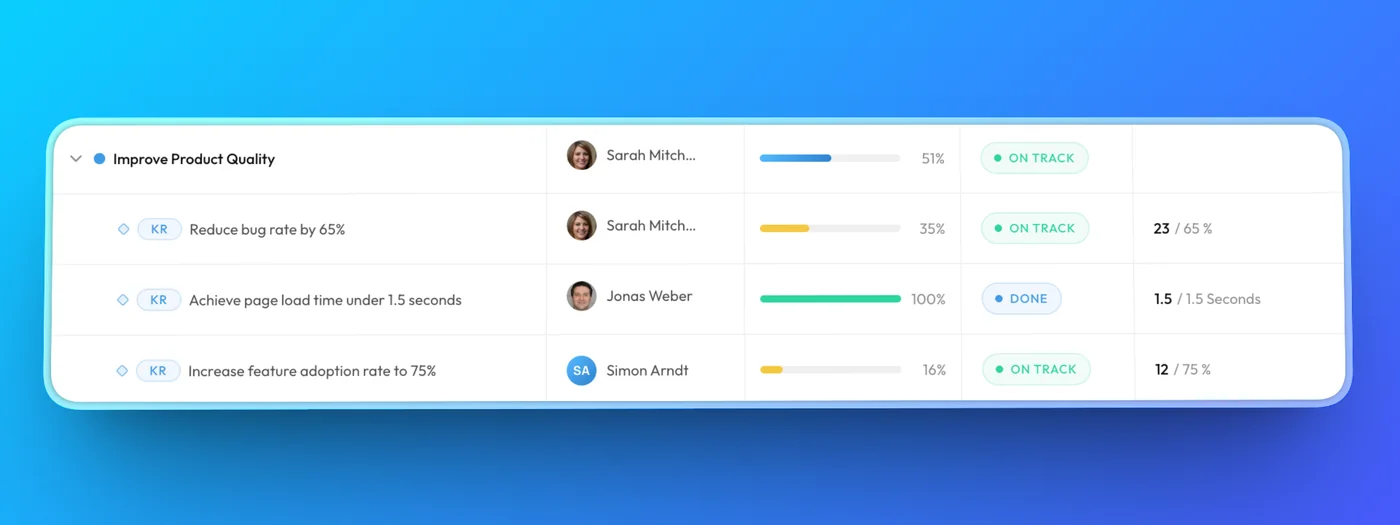
A check-in in our OKR App: update the values per Key Result, and progress is calculated automatically.
Step 6: Review and retrospective at the end of the cycle
In the final week of the cycle, the team takes stock. Each Key Result is scored on a scale from 0.0 to 1.0. For ambitious goals, a score around 0.7 is already a strong result. A team that regularly hits 100 percent has set goals that were too easy.
More important than the score is the retrospective: what drove progress, what blocked it, and which three things will you do differently next cycle? Teams that run this review consistently reach noticeably more goals the following quarter.
How the rollout becomes a cycle
OKRs are not a one-off project but a recurring rhythm. After the review, the next cycle begins, and with every round the team gets better at it.
Plan
Set Objectives and Key Results for the quarter.
Plan
Set Objectives and Key Results for the quarter.
Align
Make goals visible and connect teams to each other.
Track
Run weekly check-ins and update progress.
Review
Score, reflect and carry the lessons into the next quarter.
The most common rollout mistakes
Three patterns make rollouts fail. The first: too much at once. Converting the whole company in the first quarter and giving everyone ten goals creates chaos, not focus. The second: OKRs as a task list. As soon as Key Results become ticked-off to-dos, the outcome mindset is lost. The third: missing leadership involvement. If leaders don't take part, the team quickly learns that OKRs are optional.
In practice, things break in the second cycle. The launch energy fades right when the coaching load peaks. That is why a dedicated role helps: more than 80 percent of successful OKR programs have an OKR Champion who facilitates the process, nudges people toward check-ins and surfaces barriers early. The role needs no formal authority, just closeness to the teams, and is usually a part-time job of 20 to 30 percent at first.
What to track OKRs with
Many guides suggest starting the first cycle in a spreadsheet. In practice that creates needless manual work from day one: values are recalculated by hand, links between goals get lost and no one sees at a glance where things are stuck. Small teams are better off starting with a lightweight OKR tool right away.
Because existing OKR tools were either too bloated or too expensive for small teams, we built our own: the OKR App. It keeps Objectives and Key Results in one place, calculates progress automatically and makes alignment between teams visible. That way your team focuses on the actual work from the start instead of maintaining a spreadsheet. The fastest way in is to start for free in the beta.
Next, it is worth looking at why OKRs are becoming more relevant than ever.
Frequently Asked Questions
More articles

Game Production
History of the Unreal Engine: From 1998 to Unreal Engine 5
From its beginnings in 1998 to Unreal Engine 5: how Epic's game engine has evolved over more than 25 years, which games it shaped, and what it can do today.
Game Production
What Are Idle Games? Definition and Examples
Idle games, also called incremental games, thrive on waiting and automation. We explain the genre, its mechanics, and present well-known examples.
Ready to get started?
Let’s start your project.
We appreciate your interest in working with us. Whether you have an idea, a proposal, a question, or need assistance in another area, we’ll get back to you quickly—within 24 hours.
Free initial consultation
Response within 24h
No commitment
Contact
Get in touch
Opening Hours
Mon – Fri, 9:00 – 17:00Response Time
Within 24 hours