
By Simon Arndt · 7 min. read · Last updated: 7/20/2026
Most teams work hard. Yet by the end of the quarter, everyone has pulled in slightly different directions, and no one can say for sure whether the decisive step forward actually happened. This is exactly the problem OKRs solve. They turn vague intentions into one shared, measurable goal. This article covers what OKRs are, how Objectives and Key Results work together and what matters when you put them into practice.
What does OKR mean?
OKR stands for Objectives and Key Results. It is a goal-setting framework that splits one simple question into two parts: where do we want to go, and how will we know we are getting there?
The Objective describes the goal. It is qualitative, ambitious and written to inspire. The Key Results describe the path in numbers. They make it measurable whether the Objective has been reached. An Objective without Key Results stays a wish. Key Results without an Objective are a list of metrics with no direction. Only together do they form an OKR.
Where do we want to go? A qualitative, inspiring goal.
Measurable and verifiable
With a start and target value
Time-bound
1 Objective + 2–5 Key Results = 1 OKR
Where do we want to go? A qualitative, inspiring goal.
Measurable and verifiable
With a start and target value
Time-bound
1 Objective + 2–5 Key Results = 1 OKR
A common rule of thumb: a team sets three to five Objectives per cycle, and each Objective gets two to five Key Results. Anything more quickly becomes cluttered and dilutes the focus.
Objectives – the "what" and "why"
A good Objective answers what you want to achieve and why it matters. It should motivate, not bore. "Increase revenue" is a weak Objective because it is arbitrary. "We become the first choice for new customers in our region" gives a direction a team can rally behind.
Objectives are deliberately qualitative. They contain no numbers, because the numbers belong in the Key Results. An Objective works when everyone on the team understands it, can repeat it in one sentence and actually wants to work on it.
Key Results – how you measure progress
Key Results are the hard, measurable part. They must be written so that at the end of the cycle it is objectively clear whether they were met. Each Key Result ideally has a starting value, a target value and a current value.
The most common mistake is confusing activities with results. "Roll out a new CRM" is a task, not a Key Result. It says nothing about whether anything improved. "Cut support response time from 8 hours to 2" is a Key Result, because it describes a measurable outcome. Good Key Results are numeric, verifiable and time-bound.
A worked OKR example
Theory becomes tangible the moment you see a real OKR. Take a team that wants to improve how it onboards new customers.
New customers experience an onboarding that delights them
- 01Cut time to first value from 5 days to 1
- 02Raise the onboarding completion rate from 55% to 80%
- 03Lift the NPS of new customers from 30 to 50
The Objective reads: "New customers experience an onboarding that delights them." That is inspiring but not yet measurable. The three Key Results make it concrete: cut time to first value from five days to one, raise the onboarding completion rate from 55 to 80 percent, and lift the Net Promoter Score of new customers from 30 to 50.
At the end of the quarter, you can say precisely how far the team got on each Key Result. That is the whole point: progress becomes visible instead of a gut feeling.
How an OKR cycle works
OKRs are not an annual plan that gathers dust in a drawer. They run in short cycles, usually a quarter. This shorter cadence is one of the biggest advantages over classic annual goals, because a team can course-correct four times a year instead of once.
A cycle has four phases. First the team defines its Objectives and Key Results. Then it makes the goals visible and connects them across teams. During the quarter, regular check-ins keep the values up to date. At the end comes the review: score, reflect, carry the lessons into the next quarter. For a step-by-step walkthrough of that process, see our guide on how to implement OKRs in your team.
OKR vs. KPI – the difference in short
OKRs and KPIs are often confused, even though they do different jobs. A KPI, a Key Performance Indicator, continuously measures the state of a process. Monthly revenue, customer satisfaction or server load are KPIs. They show whether normal operations are running smoothly.
OKRs, by contrast, aim at change. They describe what you want to actively improve this quarter. A KPI observes, an OKR moves. In practice the two complement each other: a KPI that drifts off course often becomes the starting point for the next OKR. They do not compete, they work together.
Where the OKR method comes from
The idea is older than many assume. Its roots go back to Peter Drucker and his concept of "Management by Objectives" in the 1950s. At Intel, Andy Grove developed it in the 1970s into the form we know today as OKR, and documented it in his book "High Output Management".
The method became famous through Google. John Doerr, who had learned the idea from Grove as a young Intel employee, introduced it to a still-small Google in 1999. Google has run OKRs every quarter ever since, from its early days with around 40 people to today. What Google added was transparency: while Intel used OKRs mainly within teams, Google made the goals visible to everyone. Doerr's 2018 book "Measure What Matters" finally brought OKRs into the mainstream.
Who are OKRs for?
A common misconception is that OKRs are only for tech giants like Google. The opposite is true. Small and mid-sized teams benefit most, because focus is especially scarce there. A five-person team that agrees on three clear goals wastes less energy than one working on twenty things at once.
OKRs make sense wherever several people work toward a shared outcome and where priorities shift faster than an annual plan can capture. For pure routine work with no change goal, they are overkill. KPIs are enough in that case.
Committed and aspirational: two kinds of OKRs
In practice there are two types of OKRs, and confusing them is one of the biggest sources of error. Committed OKRs are promises. They are meant to be reached 100 percent, such as a release date or a contractually agreed number. Here the rule is simple: met or not, no grey area.
Aspirational OKRs, often called "moonshots", deliberately set the bar so high that reaching it fully in one quarter is unlikely. A score of 0.6 to 0.7 already counts as success here, because the team stretches beyond what it thought possible. Judging both types by the same standard leads to the wrong conclusions: a missed committed OKR is a real problem, while an aspirational OKR at 0.7 is a strong result. It pays to label from the start which type you are dealing with.
The most common beginner mistakes
Three mistakes show up almost every time teams start with OKRs. The first: too many goals. Setting ten Objectives means having no priorities at all. The second: disguising activities as Key Results. "Launch a campaign" is a task, not a result. The third: writing OKRs down once and never looking at them again until the quarter ends. Without regular check-ins, they lose their effect.
One more point concerns scoring. For ambitious OKRs, reaching around 0.7 already counts as a strong result. A team that hits 100 percent of its Key Results every time has set goals that were too easy. OKRs are meant to stretch, not to be comfortably ticked off.
Putting OKRs into practice
OKRs are quick to grasp but hard to keep clean day to day. In a spreadsheet, values are recalculated by hand, links between goals get lost and no one sees at a glance where things are stuck. Small teams are better off starting with a lightweight OKR tool right away. For exactly that reason we built one ourselves: the OKR App, lightweight and ideal for small teams starting with OKRs, keeping Objectives and Key Results in one place with progress calculated automatically.
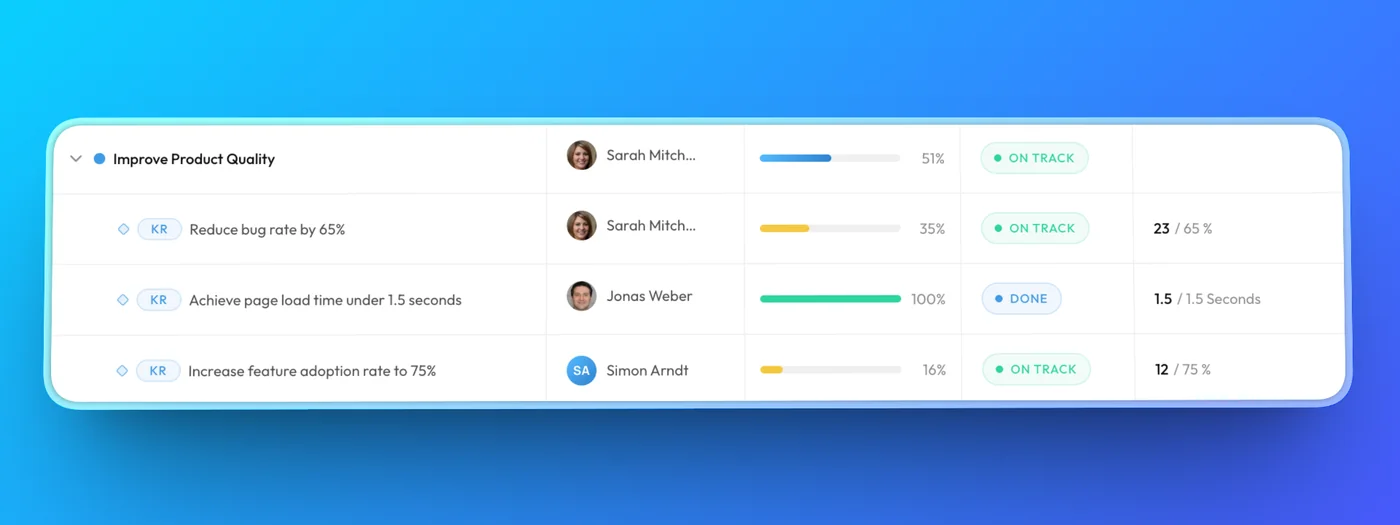
Inside the OKR App: an Objective with its Key Results and automatically calculated progress.
If you want to try OKRs directly, you can start for free in the beta.
If you want to go deeper, read next how to implement OKRs step by step and why OKRs are becoming more relevant than ever.
Frequently Asked Questions
More articles

Streaming
The Techniques Behind VStreaming
How are the avatars behind VTubing and VStreaming created? A look at 2D and 3D avatar creation, rigging, tracking software, and the hardware you need.

Gamification
What Is a Serious Game? Definition and Examples
Serious games convey knowledge in an entertaining way. We explain what defines a serious game, how it differs from gamification, and what makes it successful.
Ready to get started?
Let’s start your project.
We appreciate your interest in working with us. Whether you have an idea, a proposal, a question, or need assistance in another area, we’ll get back to you quickly—within 24 hours.
Free initial consultation
Response within 24h
No commitment
Contact
Get in touch
Opening Hours
Mon – Fri, 9:00 – 17:00Response Time
Within 24 hours